Public Cloud vs. Colocation vs. Hybrid Infrastructure: How to Compare Total Cost in 2026
Compare public cloud, colocation, and hybrid infrastructure costs across compute, data transfer, staffing, connectivity, capacity, and contract risk.
The cost comparison between public cloud and colocation is rarely answered by comparing a monthly cloud invoice with a data center quote.
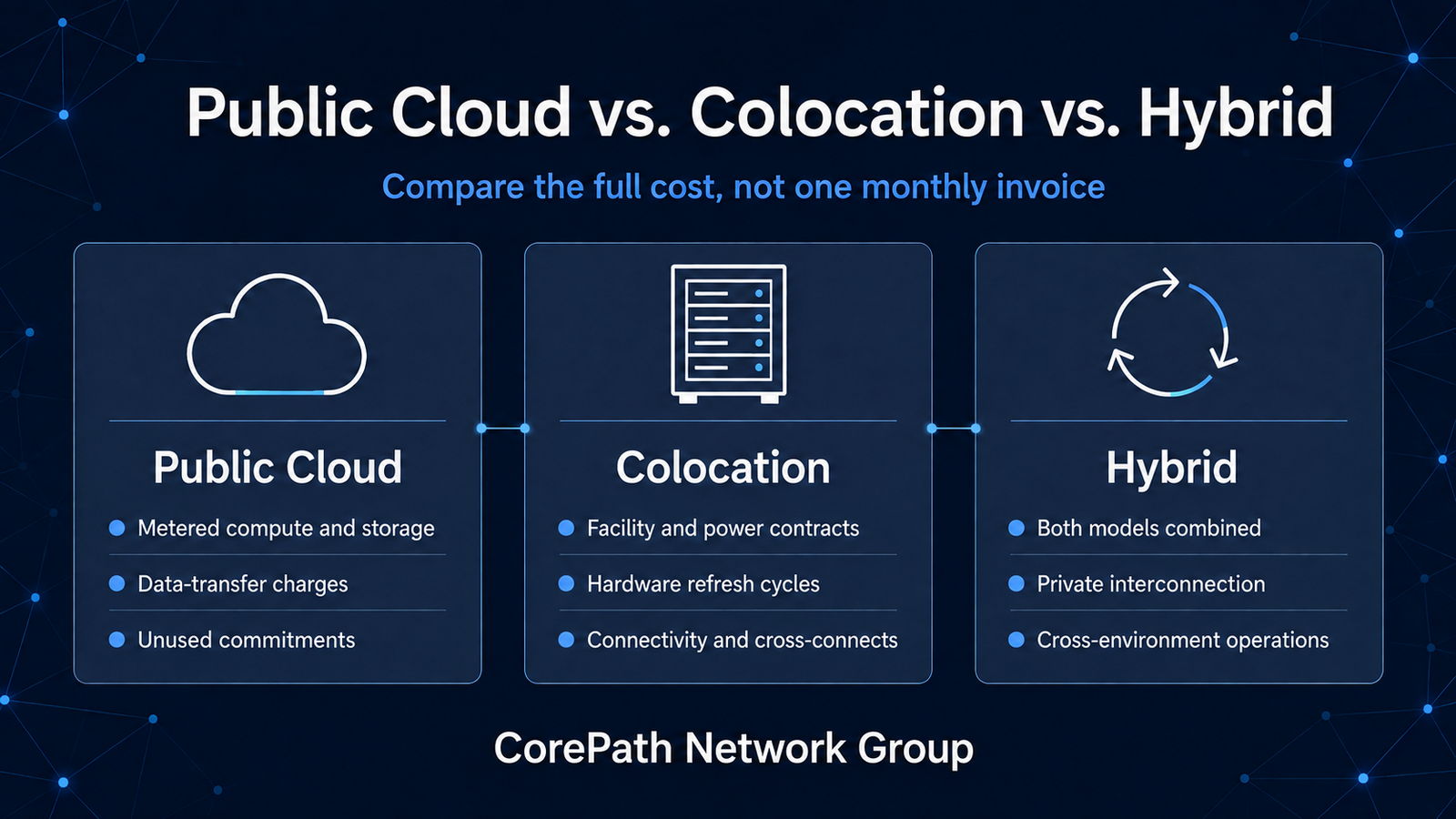
Public cloud converts infrastructure into metered services. Colocation combines contracted facility capacity with owned or leased technology. Hybrid infrastructure introduces costs from both environments, along with the connectivity and operating processes that connect them.
Each model can be financially appropriate for the right workloads. Each can also become expensive when utilization, data movement, operational responsibilities, or contract terms are misunderstood.
The right question is not whether cloud or colocation is universally cheaper.
The right question is which environment produces the best combination of cost, flexibility, performance, resilience, security, and operational fit for each workload.
Why This Comparison Matters in 2026
Infrastructure economics are changing on both sides of the decision.
Public-cloud pricing remains flexible, but the final cost depends on far more than compute. Storage transactions, data transfer, private connectivity, observability, support, public IP addresses, security services, backups, licensing, and unused commitments all affect the bill.
Commitment discounts can reduce unit prices for predictable workloads, but they also introduce financial obligations. AWS offers Savings Plans in exchange for usage commitments. Microsoft offers one-year and three-year reserved virtual machine terms. Google Cloud committed-use discounts also use one-year or three-year commitments.
Colocation faces a different form of pressure: available power and capacity.
JLL North America Data Center Report Midyear 2026 reported on August 11, 2026, that North American data center vacancy remained at 1% for the third consecutive year. JLL also reported that tenants securing capacity are often contracting for 2028 delivery.
CBRE Global Data Center Trends 2026 reported record-low vacancy during the first quarter of 2026 across the four largest US data center markets. Vacancy reached 0.3% in Northern Virginia, 1% in Atlanta, 1.8% in Dallas-Fort Worth, and 2.2% in Chicago.
These wholesale market figures should not be treated as direct pricing estimates for an individual enterprise deployment. They show why colocation capacity, power requirements, location, and timing need evaluation before approving a cloud-exit or expansion decision.
Public Cloud, Colocation, and Hybrid Infrastructure Compared
| Factor | Public Cloud | Colocation | Hybrid Infrastructure |
|---|---|---|---|
| Cost model | Metered operating expense | Contracted facility expense plus hardware | Combination of both models |
| Capacity | Provisioned through cloud services | Limited by facility, power, cooling, and hardware | Capacity distributed across environments |
| Scaling | Strong for variable and uncertain demand | Requires capacity and equipment planning | Allows workloads to scale differently |
| Commitments | On-demand or discounted commitments | Facility, power, carrier, and equipment commitments | Multiple overlapping commitments |
| Data movement | Service, regional, inter-zone, and egress charges | Carrier, cross-connect, transit, and cloud-on-ramp costs | Data transfer plus private interconnection |
| Operations | Provider operates the underlying platform | Client and selected providers divide responsibilities | Requires operating processes across both |
| Primary financial risk | Uncontrolled consumption and unused commitments | Underused capacity and inflexible contracts | Duplicated tools, staffing, and connectivity |
| Strongest potential fit | Variable demand and cloud-native services | Stable workloads with predictable capacity | Mixed portfolios with different requirements |
This table is a starting point. A defensible decision requires workload-level data.
What Belongs in a Public-Cloud Cost Model?
A cloud cost model should include every service required to operate the workload, not only the primary compute instance.
Compute
Document:
- Virtual machines
- Containers
- Kubernetes control planes
- Serverless execution
- GPU and accelerator consumption
- Autoscaling behavior
- Development and test environments
- Disaster recovery capacity
Use actual hourly consumption rather than provisioned capacity alone.
AWS EC2 On-Demand instances provide per-hour or per-second pricing without a long-term commitment for eligible operating systems. Commitment-based options reduce unit pricing but create a minimum usage obligation.
Storage
Include:
- Primary storage capacity
- Provisioned performance
- Snapshots
- Backup
- Archive tiers
- Storage transactions
- Replication
- Retrieval charges
- Retention requirements
Low-cost storage capacity can still produce a significant bill when the workload requires frequent access, high transaction volume, replication, or long retention periods.
Data Movement
Map traffic between:
- Availability zones
- Regions
- Cloud services
- The public internet
- Offices
- Colocation facilities
- Other cloud providers
- Disaster recovery environments
AWS EC2 data-transfer pricing currently provides 100 GB of aggregate monthly internet data transfer out across eligible services and regions, followed by tiered charges. AWS also identifies separate charges for many cross-Availability Zone paths and processing through services such as NAT Gateway, PrivateLink, and Transit Gateway.
Azure bandwidth pricing varies by source region, destination, and transfer direction. Azure Virtual Network pricing also charges for traffic at both ends of many virtual-network peering connections.
Google Cloud network pricing prices network data transfer out by source geography and destination, while ingress is free in many standard scenarios. Separate pricing applies to services such as Cloud Interconnect, CDN Interconnect, and Carrier Peering.
Do not estimate data-transfer costs from total storage capacity. Use measured traffic flows.
Supporting Services
Include:
- Load balancing
- Public IPv4 addresses
- DNS
- Logging
- Monitoring
- Security tools
- Key management
- Backup
- Managed databases
- Premium support
- Marketplace software
- Software licensing
- Private cloud connectivity
- Cost-management tooling
These services are easy to omit from an initial migration estimate because they are not part of the primary compute price.
Internal Operating Cost
Include the people and processes required for:
- Cloud architecture
- Security
- FinOps
- Platform engineering
- Governance
- Tagging and allocation
- Cost anomaly response
- Backup and recovery
- Vendor management
- Compliance
The State of FinOps 2026 survey included 1,192 respondents representing more than $83 billion in annual cloud spending. The survey found that FinOps responsibility is expanding beyond public cloud. Fifty-seven percent of respondents manage private-cloud costs, 48% manage data center costs, and 28% include labor.
This supports a broader total-cost model rather than treating the cloud invoice as the complete cost of the environment.
What Belongs in a Colocation Cost Model?
Colocation replaces some cloud-service charges with facility, equipment, network, and operating expenses.
Facility Costs
Include:
- Cabinets or cage space
- Committed power
- Metered power
- Power overages
- Cooling requirements
- High-density charges
- Cross-connects
- Internet transit
- Private circuits
- Cloud on-ramps
- Remote hands
- Staging and storage
- Shipping and receiving
- Annual escalators
- Taxes and pass-through charges
Compare proposals using the same power, density, connectivity, support, and contract assumptions.
Hardware Costs
Include:
- Servers
- Storage
- Network equipment
- Firewalls
- Load balancers
- Spare equipment
- Support contracts
- Warranty extensions
- Hardware refresh cycles
- Financing or lease costs
- Shipping
- Installation
- Secure disposal
Annualize capital purchases across a realistic useful life, but include the cash-flow impact and refresh risk separately.
Software and Platform Costs
Colocation does not eliminate software expense.
Include:
- Virtualization
- Operating systems
- Databases
- Backup platforms
- Monitoring
- Security tools
- Automation
- Configuration management
- Data protection
- Management platforms
Licensing terms can change when workloads move between shared cloud services, dedicated hardware, and virtualized private environments.
Operating Responsibilities
Define who is responsible for:
- Hardware deployment
- Monitoring
- Patching
- Backup
- Security operations
- Capacity planning
- Incident response
- Hardware replacement
- Network management
- Vendor coordination
- Disaster recovery testing
The facility operates the data center. The facility does not automatically operate the client's servers, applications, security stack, or network.
Capacity and Contract Risk
Colocation economics depend on securing enough capacity without paying for excessive unused space or power.
Review:
- Minimum power commitments
- Expansion rights
- Adjacent capacity
- Power reservation terms
- Annual escalators
- Renewal language
- Assignment rights
- Reduction rights
- Early termination
- Migration access
- Exit assistance
For a deeper contract review, use the CorePath Colocation Contract Renewal Guide.
What Belongs in a Hybrid-Infrastructure Cost Model?
Hybrid infrastructure is often presented as a compromise between cloud and colocation. Financially, hybrid infrastructure is its own operating model.
Add the public-cloud and colocation costs, then include:
- Private interconnection
- Redundant carrier circuits
- Cloud on-ramp ports
- Cross-connects
- Data-transfer charges
- Routing and security infrastructure
- Identity integration
- Duplicate monitoring tools
- Duplicate backup systems
- Data synchronization
- Cross-environment disaster recovery
- Staff with skills across both environments
- Migration and application-refactoring costs
Hybrid infrastructure is not automatically less expensive. Hybrid infrastructure becomes valuable when workloads are placed intentionally and the cost of connecting the environments is understood.
For more detail on data-transfer exposure, review the CorePath Cloud Egress Costs Guide.
When Public Cloud Often Fits Best
Public cloud deserves serious consideration when a workload has:
- Uncertain or highly variable demand
- Short deployment duration
- Rapid geographic expansion requirements
- Heavy dependence on managed cloud services
- Limited internal infrastructure operations
- A need for fast experimentation
- Seasonal or event-driven capacity
- Architectures designed to scale down as effectively as they scale up
The strongest economic benefit comes from using cloud characteristics intentionally. Moving a static architecture into metered infrastructure without redesigning the architecture can preserve the old operating model while adding new service charges.
For workloads where environment matters, a cloud placement review can help identify which workloads are well-suited to public cloud and which are not.
When Colocation Often Deserves Evaluation
Colocation deserves consideration when a workload has:
- Stable, predictable utilization
- Large sustained compute or storage requirements
- Specialized hardware
- Strict hardware-control requirements
- High and predictable data-transfer volume
- Existing infrastructure operations capability
- Long equipment life
- Direct carrier or cloud-connectivity requirements
- Latency-sensitive dependencies
- A need for consistent capacity over several years
Colocation still requires a facility and hardware strategy. Tight capacity conditions mean the lowest theoretical cost is irrelevant if suitable power, cooling, connectivity, or expansion capacity is unavailable on the required timeline.
A strategic colocation evaluation should include requirements documentation, facility comparison, connectivity planning, and contract review before committing to a provider.
When Hybrid Infrastructure Often Makes Sense
Hybrid placement is worth evaluating when:
- Different workloads have materially different requirements
- Data must remain in a controlled environment while applications use cloud services
- Steady-state workloads coexist with variable demand
- A staged migration is operationally safer than a full move
- Cloud services depend on private data or legacy systems
- Disaster recovery spans multiple infrastructure types
- The organization needs public-cloud flexibility without placing every workload there
The architecture should define which system belongs in each environment and why. "Hybrid" should not become a permanent label for workloads that were never evaluated.
How to Build a Defensible Comparison
1. Collect 12 Months of Actual Data
Gather:
- Cloud invoices and usage exports
- Workload utilization
- Storage growth
- Data flows
- Network bills
- Software licenses
- Support agreements
- Current contracts
- Internal labor estimates
- Incident and availability requirements
Twelve months captures seasonality that a single monthly invoice misses.
2. Classify Each Workload
Document:
- Business owner
- Technical owner
- Utilization pattern
- Growth
- Data location
- Data-transfer volume
- Latency
- Availability
- Recovery requirements
- Security and compliance
- Application dependencies
- Operational ownership
Do not place every workload into the same scenario.
3. Model Three Scenarios
Create comparable models for:
- Public-cloud optimization
- Colocation or private infrastructure
- Hybrid workload placement
Use a minimum 36-month horizon. For hardware-heavy scenarios, also model 60 months.
4. Normalize the Assumptions
Use the same:
- Demand forecast
- Availability target
- Recovery objective
- Security requirements
- Data-retention period
- Staffing assumptions
- Growth rate
- Migration scope
- Contract timeline
A cheaper scenario is not comparable if the scenario provides less resilience, support, or capacity.
5. Stress-Test the Result
Model what happens if:
- Demand grows faster than expected
- Demand falls
- Data transfer doubles
- Cloud commitments are underused
- Colocation capacity is underused
- Equipment requires early replacement
- Power prices increase
- A migration is delayed
- A provider raises renewal pricing
- The organization acquires or divests a business
The best option should remain supportable under more than one forecast.
A Practical Total-Cost Framework
Use these categories:
Public-Cloud TCO
Compute + storage + managed services + data movement + connectivity + security + observability + support + licensing + commitments + internal labor + migration
Colocation TCO
Facility + power + hardware + maintenance + software + connectivity + remote hands + internal labor + disaster recovery + migration + contract exposure
Hybrid TCO
Public-cloud TCO + colocation TCO + interconnection + duplicated tools + data synchronization + cross-environment operations
Pricing calculators help estimate provider charges, but they do not replace an architecture and operating-cost review. AWS, Azure, and Google Cloud each provide official calculation tools: AWS Pricing Calculator, Azure Pricing Calculator, Google Cloud Pricing Calculator.
Frequently Asked Questions
Is Colocation Cheaper Than Public Cloud?
Not universally. Colocation can produce favorable economics for stable, highly utilized workloads, but requires hardware, operations, connectivity, capacity, and contract commitments. Public cloud can be more efficient for variable demand and workloads that benefit from managed services.
What Is the Most Overlooked Public-Cloud Cost?
Data movement is frequently underestimated because charges depend on the source, destination, service path, region, and architecture. Support, observability, backup, security, and unused commitments also deserve review.
What Is the Most Overlooked Colocation Cost?
The facility quote often excludes hardware, software, connectivity, remote hands, staffing, refresh cycles, migration, and future expansion. The lowest cabinet or power rate does not represent total cost.
Is Hybrid Infrastructure Cheaper?
Not automatically. Hybrid placement can improve workload fit, but hybrid placement introduces interconnection and cross-environment operating costs. Hybrid infrastructure creates value when each workload has a defined placement rationale.
Should an Organization Leave Public Cloud Because Its Bill Increased?
An increased bill should trigger analysis, not an automatic exit. Review utilization, architecture, commitments, data transfer, unit economics, and workload requirements before deciding whether to optimize, repatriate, or adopt a hybrid model.
Compare the Infrastructure Options Before Committing
CorePath Network Group helps mid-market and enterprise IT and finance teams evaluate public cloud, private infrastructure, colocation, connectivity, provider options, and commercial terms through an independent, vendor-agnostic process.
Our role is to document requirements, compare qualified options, review cost and contract considerations, and coordinate the selected sourcing path. CorePath is not an MSP or infrastructure operator. Selected providers remain responsible for service delivery and technical operations.
For standard sourcing engagements, CorePath receives compensation from the selected provider or distribution partner after deployment. The client pays no direct advisory fee for this sourcing model and retains final authority over provider and contract decisions.
Explore Topics
Written by
CorePath Network Group
CorePath Network Group provides independent, vendor-agnostic advisory across colocation, cloud placement, connectivity, and infrastructure procurement. The team helps mid-market and enterprise organizations compare providers, negotiate contracts, and coordinate complex deployments.