
Cloud Egress Costs: How to Audit Data Transfer and Workload Placement
Learn how AWS, Azure, and Google Cloud data transfer pricing affects workload economics, and how to audit egress before changing architecture.
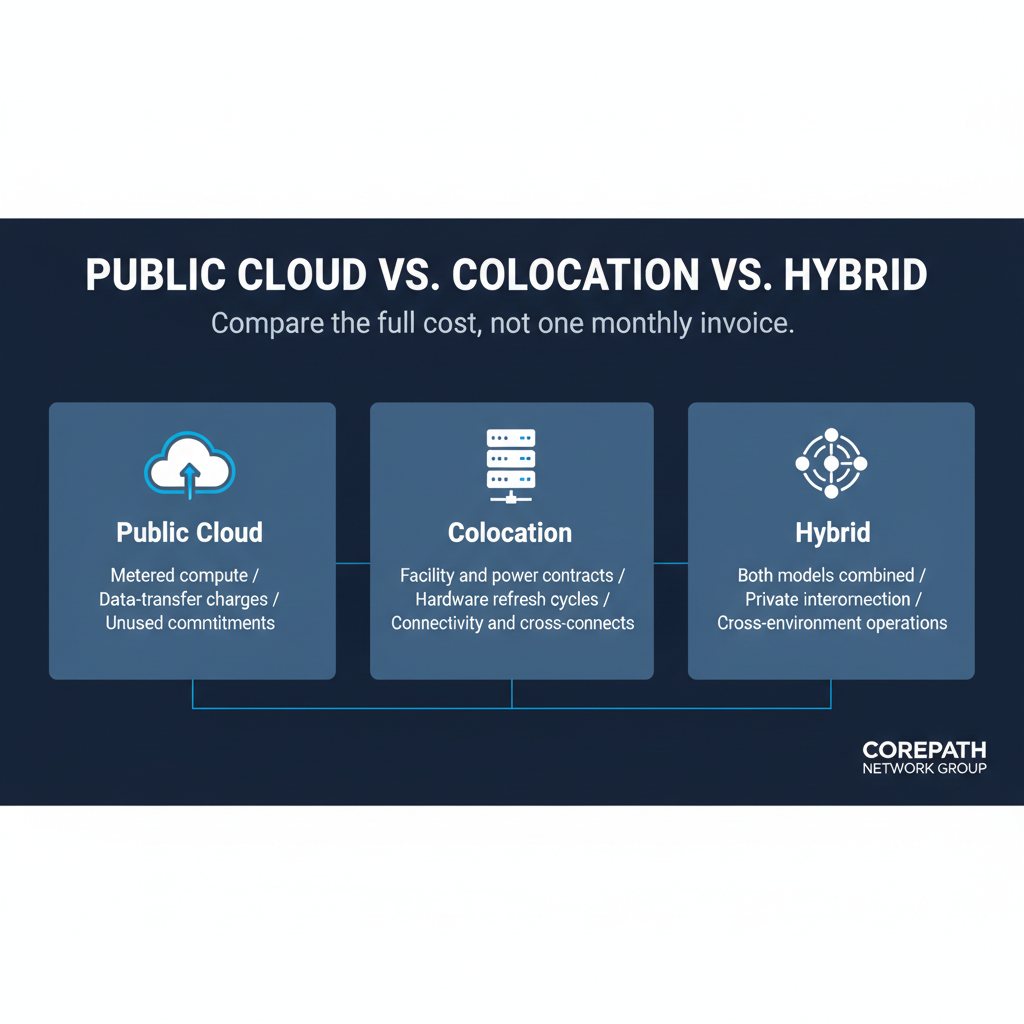
Cloud egress costs depend on where data originates, where data goes, which cloud service handles the traffic, and how the traffic leaves the environment.
For IT and finance teams, the first step is not moving workloads out of public cloud. The first step is identifying which data flows generate charges and measuring their effect on total workload economics.
A structured review should separate internet data transfer, regional transfer, cross-zone traffic, private connectivity, CDN traffic, replication, backup traffic, and other network services before any placement decision is made.
What Cloud Egress Actually Means
Egress generally describes data leaving a cloud service, network, region, or environment.
Billing treatment differs across providers and services.
AWS states data-transfer charges vary based on the services involved and the source AWS Region. (AWS documentation)
Microsoft Azure states inbound data transfer is generally free while outbound and inter-region transfer pricing depends on the applicable bandwidth service and region. (Azure pricing)
Google Cloud separates data-transfer pricing across internet traffic, zones, regions, Cloud Interconnect, and other networking services. (Google Cloud VPC network pricing)
These differences make broad statements such as "egress costs X percent of cloud spend" unreliable without reviewing the individual environment.
Why Data Transfer Costs Become Material
Data-transfer charges become more important as applications move greater volumes of data between locations.
Common sources include:
- Applications delivering large volumes of data to users
- Analytics platforms moving datasets between environments
- Backup and disaster recovery replication
- Cross-region application architectures
- Multi-cloud data movement
- APIs exchanging large payloads
- Cloud-to-colocation traffic
- Cloud-to-on-premises traffic
- CDN origin traffic
- Data replication between services
The financial impact depends on architecture and traffic patterns.
Two workloads with similar compute and storage requirements might have different network economics because their data flows differ.
Start With Billing Data
Begin with the cloud billing data already available to your organization.
Review a meaningful historical period and identify charges associated with:
- Internet data transfer out
- Regional data transfer
- Cross-zone traffic
- NAT gateways
- Network gateways
- Load balancers
- CDN services
- Interconnect services
- Replication
- Backup traffic
- Private connectivity
- Managed networking services
Separate recurring network charges from usage-based transfer charges.
The goal is to understand which services and workloads generate the spend rather than grouping every network-related line item under "egress."
Map the Data Flows
Billing data explains where money is being spent.
A data-flow map explains why.
For each material workload, document:
- Source environment
- Destination environment
- Direction of traffic
- Monthly data volume
- Region
- Availability zone
- Network path
- Cloud service involved
- Internet or private connectivity path
- Replication requirements
- Application dependency
- Business purpose
This creates a stronger basis for evaluating architecture changes.
Classify Workloads Before Changing Placement
Data-transfer expense alone should not determine workload placement.
Evaluate each workload across:
- Demand variability
- Compute requirements
- Storage requirements
- Data-transfer patterns
- Latency
- Availability
- Security
- Compliance
- Recovery requirements
- Operational support
- Licensing
- Growth expectations
- Migration complexity
- Contract commitments
Public cloud might remain the best environment for a workload with significant egress.
A private or hybrid environment might provide better economics for another workload.
The decision requires a complete comparison. CorePath's cloud placement and optimization advisory is designed to help organizations work through this analysis.
For a complete cloud versus colocation cost comparison, review our public cloud, colocation, and hybrid infrastructure guide.
Optimize the Existing Cloud Architecture First
Before evaluating migration, review the current architecture for avoidable data movement.
Areas to examine include:
- Unnecessary cross-region replication
- Cross-zone traffic patterns
- Poor application and database placement
- CDN configuration
- Caching strategy
- Backup locations
- Analytics pipelines
- API traffic
- NAT gateway usage
- Network topology
- Cloud contract and committed-spend structure
Some problems come from architecture rather than workload placement.
Reducing unnecessary data movement inside the existing environment might improve cost predictability without requiring a migration.
Private Connectivity Changes the Economics
Organizations moving large volumes of data between cloud and private infrastructure should also evaluate private connectivity.
Examples include:
- AWS Direct Connect
- Azure ExpressRoute
- Google Cloud Interconnect
These services provide private connectivity paths with pricing models different from standard internet data transfer.
They do not automatically eliminate data-transfer costs.
AWS Direct Connect includes port-hour and Data Transfer Out pricing. (AWS Direct Connect pricing)
Azure ExpressRoute offers metered and other connectivity models with pricing based on circuit configuration and geography. (Azure ExpressRoute pricing)
Google Cloud Interconnect charges for connections, attachments, and applicable Data Transfer Out. Google states Interconnect Data Transfer Out receives discounted pricing compared with general network pricing. (Google Cloud Interconnect pricing)
Evaluate circuit charges, provider charges, cross-connects, transfer pricing, redundancy, and bandwidth requirements as part of the total comparison.
CorePath's resilient connectivity advisory covers private connectivity evaluation as part of a broader infrastructure review.
When Hybrid, Private Cloud, or Colocation Deserves Evaluation
Some workloads deserve comparison across multiple placement options.
Examples include workloads with:
- Predictable long-term resource requirements
- High data-transfer volumes
- Significant private connectivity requirements
- Specialized hardware requirements
- Strict latency requirements
- Data-location requirements
- Existing colocation infrastructure
- Long-term capacity requirements
- Hybrid dependencies
The evaluation should compare public cloud, private cloud, hybrid architecture, and colocation based on total workload economics.
CorePath's strategic colocation advisory covers colocation evaluation as part of a complete infrastructure comparison.
Do not assume private infrastructure produces a lower total cost.
Include in the comparison:
- Compute
- Storage
- Data transfer
- Connectivity
- Licensing
- Support
- Hardware
- Facilities
- Backup
- Security
- Internal operations
- Migration expenses
- Contract commitments
- Resilience requirements
The correct placement depends on the complete workload profile.
Cloud Cost Optimization Is a Business-Value Exercise
Cloud financial management should focus on business value rather than cost reduction alone.
The FinOps Foundation defines FinOps around maximizing technology business value, data-driven decision-making, and collaboration between engineering, finance, and business teams. (FinOps Foundation)
A lower infrastructure bill provides little value if the new architecture creates greater operational risk, reduces scalability, or increases management requirements.
For this reason, CorePath evaluates workload economics alongside performance, resilience, migration complexity, provider options, and contract structure.
What a Cloud Egress Audit Should Produce
A useful review should provide:
- A baseline of current data-transfer spending
- A map of material data flows
- Transfer costs associated with individual workloads
- Architecture issues creating unnecessary traffic
- Current-cloud optimization opportunities
- Private connectivity scenarios
- Alternative workload-placement scenarios
- Migration requirements
- One-time transition expenses
- Recurring infrastructure costs
- Contract considerations
- Operational risks
The result should give IT and finance teams enough information to compare options using consistent assumptions.
No predetermined architecture should be selected before this analysis is complete.
Questions to Ask Before Moving a Workload
Before changing workload placement, answer:
- Which data flows generate the current transfer charges?
- Which charges result from application architecture?
- Which charges result from workload placement?
- What changes are available inside the current cloud environment?
- Would private connectivity change the network economics?
- What migration costs would a new environment introduce?
- Would the new architecture maintain required performance and resilience?
- What contractual commitments affect the decision?
- How will the environment be managed after migration?
- What does the total cost comparison look like under the same workload assumptions?
These questions create a better decision framework than comparing a cloud bill with a private-cloud quote.
Need Help Evaluating Cloud Placement?
CorePath Network Group provides independent, vendor-agnostic advisory across public cloud, private cloud, hybrid infrastructure, colocation, and connectivity.
We help IT and finance teams analyze workload requirements, data-transfer exposure, provider options, migration considerations, and total infrastructure economics before making a placement decision.
Explore Topics

Written by
CorePath Network Group
CorePath Network Group provides independent, vendor-agnostic advisory across colocation, cloud placement, connectivity, and infrastructure procurement. The team helps mid-market and enterprise organizations compare providers, negotiate contracts, and coordinate complex deployments.